
When WooCommerce fits
WooCommerce is a strong candidate when platform control and a broad extension model matter more than a single managed supplier. The core platform is free and open source, but that does not make the store free to operate: hosting, payment processing, extensions, security, maintenance and specialist time must be modelled as one system.
Affiliate link: we may earn a commission if you continue through this link, at no extra cost to you. Compensation does not affect our assessment.
Strengths to evaluate
- The open-source WordPress model gives teams control over hosting, store data and the implementation stack
- A broad extension model and developer APIs support specialised products, fulfilment and operational workflows
- Content publishing and commerce can share the same WordPress environment when editorial reach is central to the business
Limitations and trade-offs
- The merchant owns more of the operational burden, including hosting choices, updates, backups, security and extension compatibility
- Support may be split between the host, theme supplier, extension vendors, payment provider and implementation partner
- The free core can obscure total cost when premium extensions, performance work and ongoing technical help are required
A workflow to evaluate in WooCommerce
One item, two sizes, separate stock and a Swedish delivery zone. The retained test below covers product administration and shipping setup; this walkthrough also explains what to inspect next.
These steps combine linked product documentation with our evaluation questions. They are not a record of our own completed product test. Retained test results are identified separately below.
Separate the variations
Variable products let you use attributes such as size and configure variations. Give the example two explicit sizes rather than two near-identical standalone products.
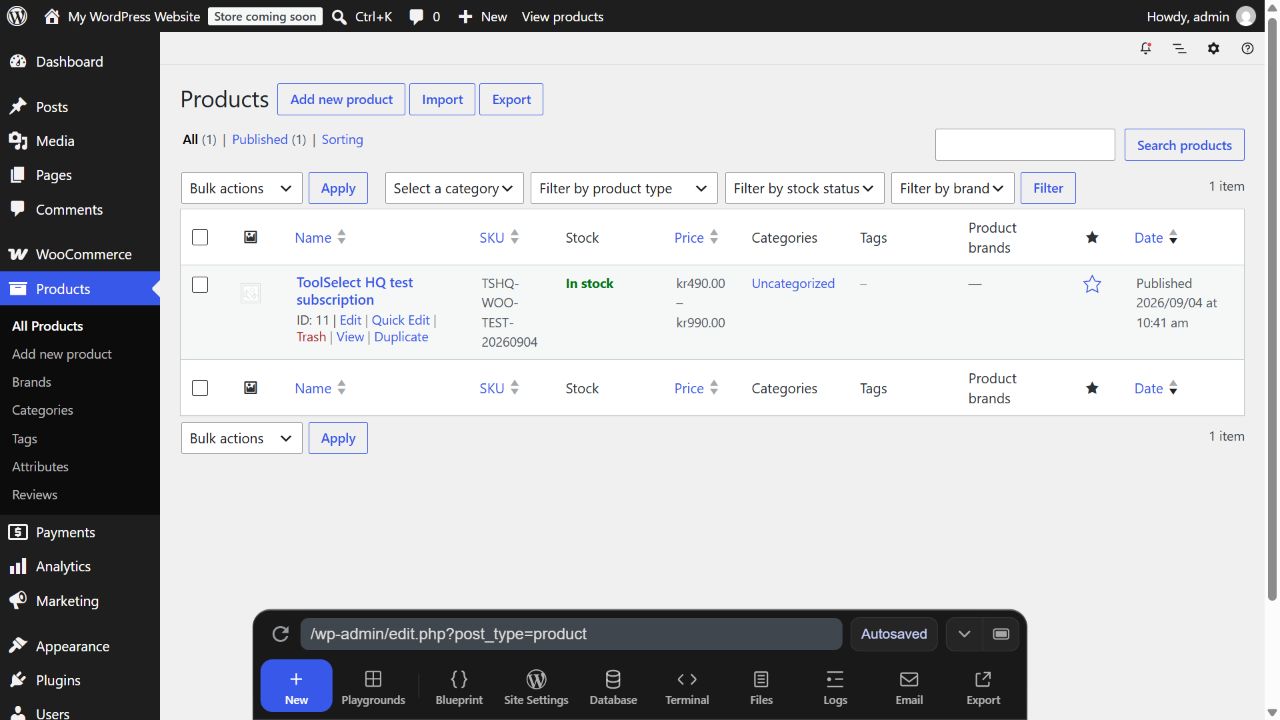
Can customers identify the correct size, and can staff distinguish it in the product record? See the retained product-list screenshot below.
Check price and stock
Variation settings support individual prices and stock handling. For the example, give each size its own SKU and inspect both an available and unavailable choice.
The price range must not hide which option is actually purchasable. The unavailable-choice check is a proposed next step, not a completed finding.
Continue beyond the product
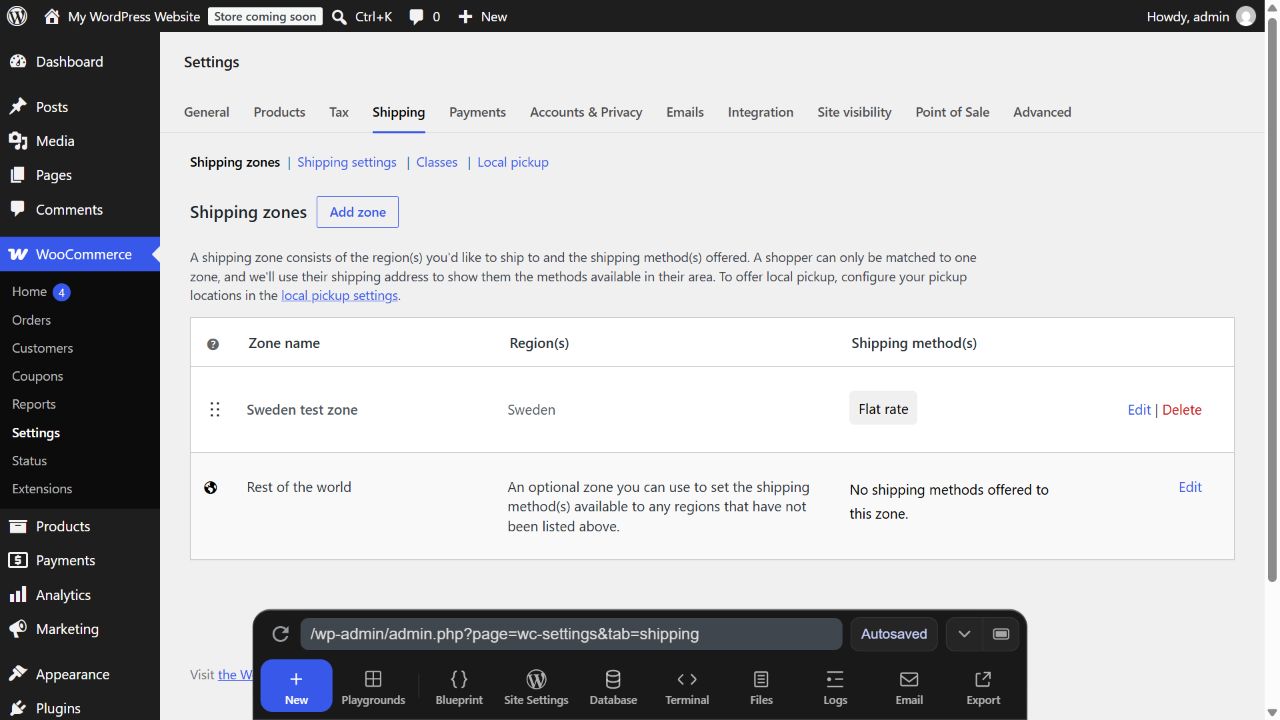
The existing journal records a saved Sweden flat-rate zone. Payment checkout, refunds, independent CSV delivery and backup restoration were not completed in that run.
Before choosing the stack, verify an order and recovery with the actual host and payment setup. A Playground admin test cannot establish production reliability.
Source material checked:
How we assess the product
We only show criteria with published evidence notes. Levels are editorial conclusions based on labelled evidence—never commission or user ratings.
Easy to get started
GoodRequires more responsibility for technology, security and maintenance.
Vendor verifiedFirst-party source: WooCommerce platform overview · 2026-08-31 ↗Integrations
Very strongThe open ecosystem provides broad extensibility.
Vendor verifiedFirst-party source: WooCommerce platform and extensions · 2026-08-31 ↗Technical control
Very strongOffers substantial control over WordPress, hosting and customisation.
Vendor verifiedFirst-party source: WooCommerce download and ownership · 2026-08-31 ↗What does WooCommerce cost?
The core platform is free and open source. Total cost depends on hosting, payment processing, extensions, theme, maintenance and any expert help.
- Starting price
- Not published here—check current pricing
- Free plan
- Yes, according to vendor pricing information
- Last checked
- 2026-08-30
Verified pricing facts
- Checked
- 2026-08-30
Actual hosting cost depends on provider, traffic and performance requirements.
- Checked
- 2026-08-30
- Market
- Vendor estimate / USD
- Checked
- 2026-08-30
Free and differently priced extensions also exist.
- Checked
- 2026-08-30
- Market
- Vendor estimate / USD
Affiliate link. We may earn a commission at no extra cost to you.
Source: the provider’s current price list ↗Prices, promotions, taxes and plan limits can change. Market and currency are shown when the source is localised. Always confirm the final price with the vendor.
Verified 12-month baseline: Shopify or WooCommerce
This scenario compares only published baseline costs in USD. It is not a quote and does not make the platforms technically equivalent.

Shopify Basic
Basic with annual billing for one store.
- Basic subscription$29 USD/month, billed annually.$29/monthShopify pricing · 2026-08-30 ↗
- Apps, themes and paymentsVaries with store choices and transactions; not included.Variable—not includedShopify pricing · 2026-08-30 ↗
WooCommerce
Free core platform with the vendor's published hosting range.
- Core platformNo monthly subscription fee.
- HostingWooCommerce estimates $25–$350 USD/month for most stores.$25–$350/monthWooCommerce pricing · 2026-08-30 ↗
- Extensions, payments and expert helpDepends on features, providers and operating ownership; not included.Variable—not includedWooCommerce pricing · 2026-08-30 ↗
- Payment processing and transaction costs are not included.
- Apps, themes, extensions, development, migration and administration are not included.
- Tax, currency and local pricing must be confirmed at checkout.
How we verified and tested
- Evidence status
- Hands-on tested
- Test status
- Limited workflow test completed — see scope below
- Documentation checked
- 2026-08-30
- Hands-on test date
- 2026-09-09
- Plan tested
- WooCommerce 11.1.0 (free core plugin) on WordPress 7.1 and PHP 8.3.33 in an isolated browser-based WordPress Playground site
Workflow test log
- Install WooCommerce and complete store setup · Completed
The plugin activated successfully and created the expected store, product, payment and analytics administration areas.
- Create products and variants · Completed
A representative variable product was published with a unique SKU, two team-size variations, SEK prices and in-stock status.
- Configure shipping, tax and a sandbox payment · Partially completed
Sweden, SEK and tax calculation were configured and a Sweden shipping zone with flat rate was saved. An offline test method was enabled, but no gateway sandbox checkout was completed.
- Import a three-product CSV catalogue · Completed
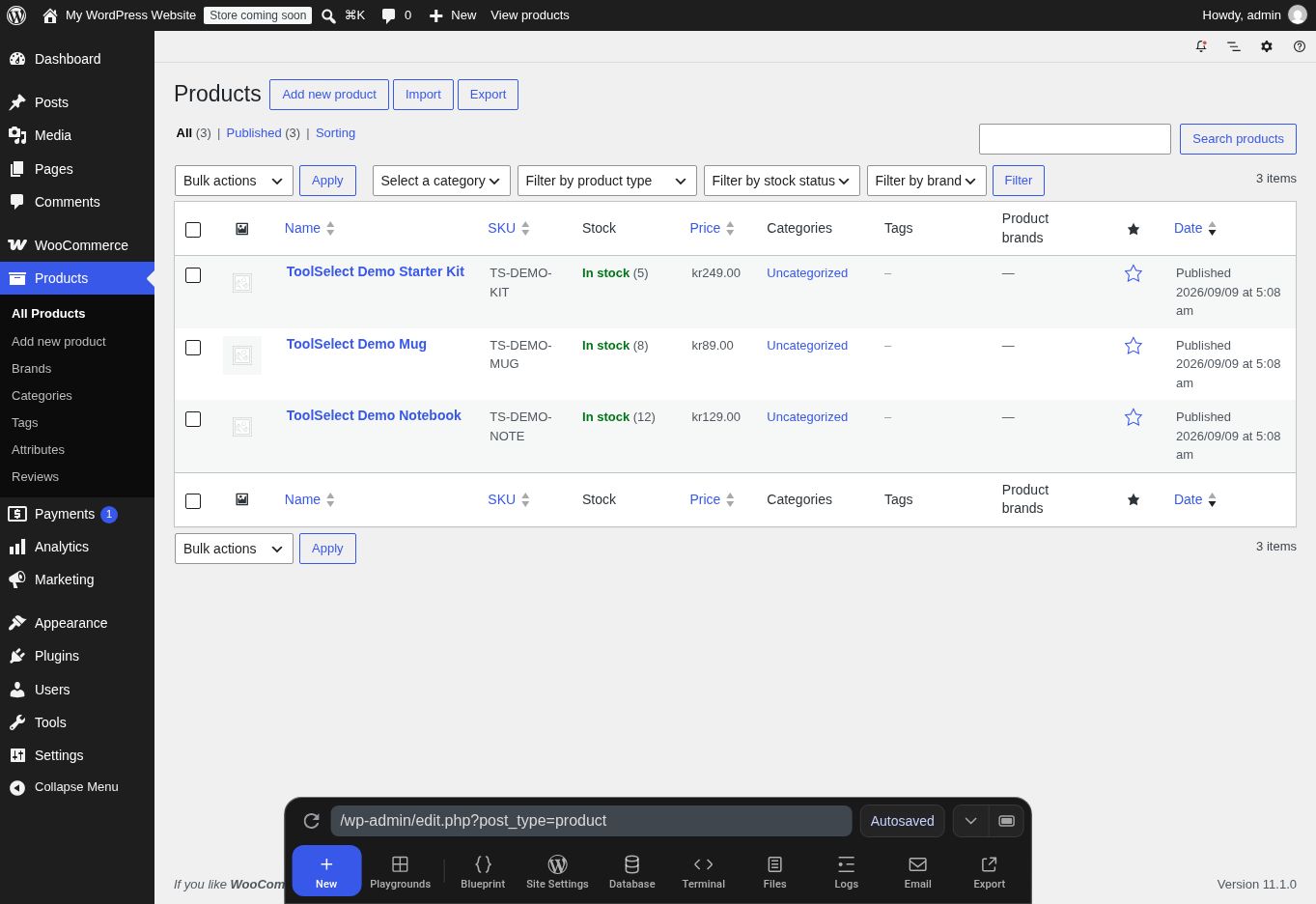
On 9 September, the core CSV importer was invoked programmatically. All three products imported without failed or skipped rows. The admin list confirmed SKUs, prices of SEK 129/89/249 and stock of 12/8/5. The browser upload wizard was not tested.
- Calculate a test order and reduce stock · Completed
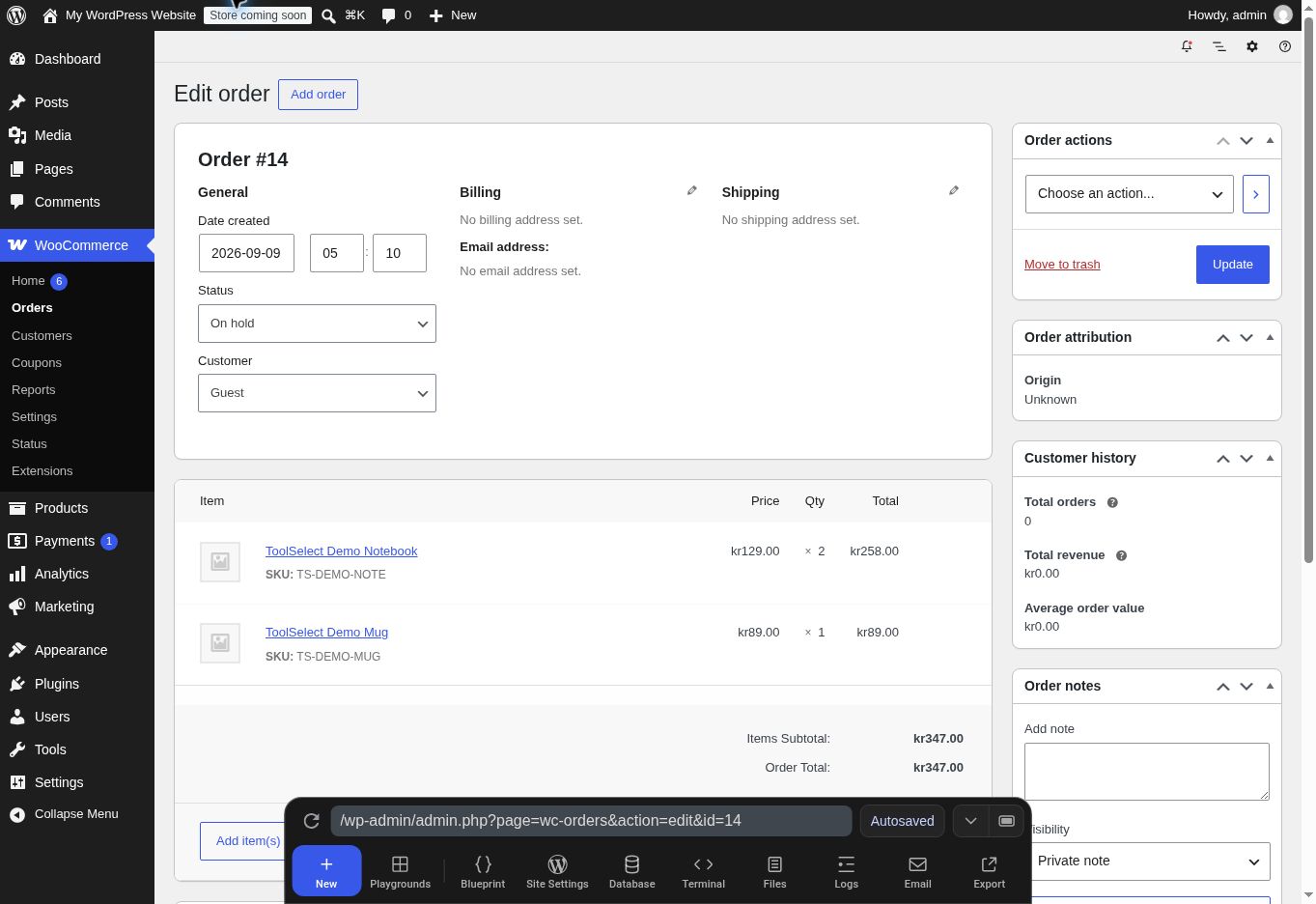
A programmatic order for two notebooks and one mug totalled SEK 347. Setting it on hold reduced stock from 12 to 10 and 8 to 7. The order was inspected in admin. Email was suppressed; no checkout or payment was performed.
- Install, update and remove an extension · Not performed
- Back up and export store data · Partially completed
The product CSV export wizard was opened with product and variation fields available. File delivery and backup restoration were not completed in this run.
Observations
- Core store administration, variable-product creation and shipping-zone setup worked in the isolated test environment.
- The product list exposed SKU, stock and the variation price range without opening the editor.
- Shipping configuration clearly separated a named Sweden zone from the rest-of-world fallback.
Limitations
- The run used WordPress Playground rather than a production host, so hosting performance, updates, security operations and persistent backups were not assessed.
- No live or sandbox card payment, tax calculation at checkout, complete order lifecycle or refund was completed. The 9 September follow-up covered programmatic import, order calculation and stock reduction, with admin inspection; it did not test manual order entry.
- A separate extension was not installed, updated and removed, and the generated CSV file delivery was not independently verified.
Screenshots
What the evidence labels mean
- Hands-on tested
- Observed in a recorded product workflow by ToolSelect HQ.
- Vendor verified
- Checked against current first-party product documentation. It is not a hands-on finding.
- Third-party verified
- Corroborated by an identified independent source.
- Not tested
- Not yet verified through a product test or sufficient source evidence.
Check before buying
- Who will own updates, backups, security monitoring and incident response after launch?
- Which extensions are essential, who maintains them and what is their combined annual cost?
- Can the chosen host support expected traffic, catalogue size, checkout load and recovery requirements?
- How will payments, tax, shipping, accounting, stock and customer service connect?
- Does the team value infrastructure control enough to justify the additional operating responsibility?